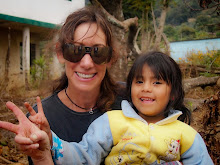
I failed to mention in my last entry, that I did finally venture into the allegedly croc and bilharia-infested Lake Malawi. It was late afternoon and we had spent the day walking up and down the beach. Yosy and I befriended a local vendor (it only cost us a t-shirt) who gave us a private tour of the few villages that sit right on the shore front. We went into homes, had conversations with the locals and even played a few games with the kids. Yosy helped one of the local fisherman pull his boat, a hollowed-out tree trunk, onto land. The villages were spotless. Women actually sweep the sand around their straw huts to get rid of any debris that washes up. I had passed the villages the day before on a late-afternoon jog. As always, Mzungus (white people) are like celebrities. All along my run people waved and children ran to greet me and hold my hand - some even ran along with me for a few hundred feet. When the run was over, I knew I had to return and meet some of these people. Our vendor-cum-tour guide was our entree to their world. These Africans thrive in spite of their governments, who do absolutely nothing for them - they have no water, no sewer, no roads, no sidewalks. There can be as many as 70 kids in one classroom. Healthcare is practically non-existent. But the Kenyans, Ugandans, Rwandans, Tanzanians and Zambians, manage to live, not just exist, despite the failures of their leaders.
Anyway, it was late afternoon and I was so hot. We had an impromptu game of volleyball on the beach and I couldn't take the heat anymore. The lake was calling me. I dove in and swam and swam and swam. The water was quiet and cool. And the crocs were otherwise engaged. As for the bilharzia worm - a simple test and pill will cure that when I get home, if needed.
Two mornings ago someone accidentally left the gate open to the hotel property where we were staying in Lusaka, the capital of Zambia. We had just finished breakfast and were preparing to leave when a small herd of Zebra wandered in and among the camp grounds. We were so close to them we could practically pet them. It was amazing. The night before some monkeys were sitting just outside our door. I was certainly more surprised than they when our paths crossed.
We are now in Livingstone (named for THE Dr. Livingstone, I presume). Victoria Falls are only 2500 feet from our hotel. The Falls are called The Smoke That Thunders in the the local language - and for good reason. In our walk around the Falls today we got drenched. They are so huge (second biggest in the world) that the volume of water produces thick mist - so thick that the Falls are not even visible unless and until there is a break in the mist and the sun shines on them. There is a very wet, slippery path opposite the Falls, across a gorge that is only a few hundred feet from all that falling water. The path runs along the gorge's rim, with no handrails. I cannot believe that some tourist has not slipped and fallen into the whirlpool below. The Falls are huge and wide and go on forever. They span the border of Zambia and Zimbabwe. The path is so close to the Falls that the spray of the water crashing into the gorge creates torrential, unrelenting, unceasing, rain in certain areas. Although we were wearing TWO rain ponchos, we were completely drenched - from head to foot. The smokey mist was so dense, and the roar was so loud we were overwhelmed. Glimpses of the Falls were mesmerizing. We just stood and watched for long stretches of time without moving.
I was very level-handed and mature today. Instead of doing the bungee jump from a bridge that spans the gorge into what is known as the Boiling Pot, below, I opted to do the zip line that goes across the gorge just below the Falls themselves. I was suspended 700 feet above the swirling water, with the thunder echoing from the cliffs, and simply sailed across. There was a perfectly round (yes, round) rainbow just below me, framing the whirlpool. I was terrified at first, but then relaxed and enjoyed the experience, which was quite like sailing in mid-air.
I have been starved for some protein since I've been here, eating no meat and only eggs, every now and then. So, yesterday, for dinner, I had crocodile appetizer. Delicious - it tasted like a cross between chicken and shrimp tempura.
Our hotel is right on the Zambesi River. Our room, with balcony,is gorgeous and although we can see the smoke of the Falls, (which rises hundreds of feet in the air), we can't hear its thunder.
We had a dinner boat ride on the Zambesi and saw some hippos. Ho hum. No big deal anymore to see wildlife. They are all around us - monkeys in the trees above our heads (or on the walkway), large spiders which make their nets in the unlikeliest of places, giraffes only outside the gates, and crocs on the dinner plate.
We are still partying with the group - We are feeling separation anxiety as we prepare to leave tomorrow morning for our flight to Cape Town.
This trip has been magical. I would stay if I didn't have kids, a dog, and bills to pay.
Tuesday, March 30, 2010


Sunday, March 28, 2010
ZAMBIA
We drove 12 hours yesterday from Lilongwe, the capital of Malawi, to the outskirts of Lusaka, the capital of Zambia. It is the first "real" city I've seen in 6 weeks - or more accurately, the city that most resembles a "real" city. There are sidewalks, hi-rises, traffic lights (and traffic) and shopping malls. I feel so civilised. Only 4 more days to Victoria Falls and the end of the overland trip. Yosy and I then fly to Cape Town for 3 days then home.
I can feel that the trip is winding down. And, its very sad.
I can feel that the trip is winding down. And, its very sad.
Wednesday, March 24, 2010
MALAWI
The road to Malawi from Dar es Salaam is long – way too long. I’m starting to get tired. Fifteen hours on a one-lane highway, in which there is two-way traffic, through some of the most verdant, quiet, peaceful hills and valleys I’ve ever seen. But its hot – over 95 degrees. There’s no a/c in the truck and if the windows are open too wide the hot wind blows dry and sticky in our faces, and disrupts our scrabble game, played to kill the boredom. There are “H’s” and “I’s” all over the floor, pieces so small that our hands have trouble placing them on the board and once lost, are gone forever among the mud, sand, cracker crumbs and general travel detritus strewn across the truck’s black bottom.
We land in Iringa, in southwestern Tanzania after 8pm and make our way to the restaurant in absolute darkness, guided only by the stars and the dirt pathways, through the brush of this high plateau. The English owners have converted mud and dung hut ruins into an eco-friendly restaurant, with only candlelight to illuminate the tables and their beautiful African-motif tablecloths. The walls are a warm rust color, uneven in height and cracked. There is an enormous palapa-thatched cone roof that rises 30 feet or more in the air. The floor is dirt and the theme is definitely primitive-chic. Each room in the “house” contains tables – some rooms are big enough only for a table for two – our room holds all 20 of us at one long banquet table. There are only about 3 or 4 rooms in all.
We start with hot squash soup, thick and spicy. The main course is “ungali,” a local staple made of maize and tasting much like polenta. Anything can be added to give it taste: tonight we have spicy meatballs in a tomato-type sauce. The vegetarians get a baked mound of cheese in the same sauce – delicious. It tastes like cheese fondue without the croutons. We are also served our first good taste of bread since we’ve been in Africa. Real, hot, freshly-baked rolls – until now there’s only been sliced white bread, or in fancier places, white bread in the shape of a baquette or a roll.
Of course, no dessert – there never is.
Although we leave as we came – by the blackness of night, we are satiated and warm, ready for another day’s long drive.
At about 2pm today, we crossed the Tanzanian border and another time zone into Malawi.
I have been meaning for weeks now to write about the sights along the roads. But its good that I waited this long. Yesterday, because the road was slow and the traffic almost non-existent, we were able to sit for the first time on the specially-designed seats on the roof of the truck. And all that we have experienced until now was intensified by the unobstructed, open-air view.
Like candidates running for office, every village ran to greet us as we passed before them. Everyone waves, some with both hands, some with only one, as the other holds on to the package of charcoal or water bucket on the head. Scores of people walking in both directions on both sides of the road, coming and going about their daily lives, also stop to wave and say hello. The kids in particular, are the most enthusiastic. Sometimes shoeless, sometimes not, they run after us on their spindly legs waving and cheering and grinning so wide their white teeth are visible from our high perch. They call out to us, laughing and yelling and waving until we can no longer see or hear them when we look back.
A word about the African couture: its obvious that most of the clothing worn by the natives throughout Africa are donations made to local charities in the western world, mostly the US, sold to middlemen and then resold to local merchants and charities. T-shirts advertise all manner of corporations, organizations and products: “The University of Tennessee Athletic Dept.,” “AIG,” and “Resprol” (misspelled and therefore sent to the charity bin). Shoes rarely fit: Children seem to wear what often look like their parents’ shoes, and adults’ shoes seem to barely fit at all. Those with shoes (and most have shoes) seem to simply wear those shoes that were available, or that they most fancied when bought. Size and comfort are irrelevant.
Our destination today is Kande Beach (pronounced “Candy”) on the shores of Lake Malawi, a lake which covers 1/3 of the country, and whose opposite shore is too far to see, although we know that Mozambique is out there somewhere. Like the Great Lakes, Lake Malawi looks like the ocean from its sandy beach shore and its waves are gentle. The wind is blowing hard and there is thunder and lightening in the distance. It’s sweltering hot, but I’m afraid to go in the water. We heard that half the leg of a Dutchman had been eaten by a Lake Malawi crocodile not that long ago. Bilharzia is also a risk. Worms that live in stagnant water, they enter and exit the body through pores in the skin after they have eaten through various organs and even the brain. We’re thinking of kayaking to cool off.
Anticipation is mounting for tonight’s meal: a whole roasted suckling pig on the spit. The pig and the charcoal was purchased from a roadside stand. Both the (live) pig and its driver met us at our destination. Here, at about 7 am, it was killed among much fanfare and ceremony and has since been turning slowly on its stick since then, head and all.
We land in Iringa, in southwestern Tanzania after 8pm and make our way to the restaurant in absolute darkness, guided only by the stars and the dirt pathways, through the brush of this high plateau. The English owners have converted mud and dung hut ruins into an eco-friendly restaurant, with only candlelight to illuminate the tables and their beautiful African-motif tablecloths. The walls are a warm rust color, uneven in height and cracked. There is an enormous palapa-thatched cone roof that rises 30 feet or more in the air. The floor is dirt and the theme is definitely primitive-chic. Each room in the “house” contains tables – some rooms are big enough only for a table for two – our room holds all 20 of us at one long banquet table. There are only about 3 or 4 rooms in all.
We start with hot squash soup, thick and spicy. The main course is “ungali,” a local staple made of maize and tasting much like polenta. Anything can be added to give it taste: tonight we have spicy meatballs in a tomato-type sauce. The vegetarians get a baked mound of cheese in the same sauce – delicious. It tastes like cheese fondue without the croutons. We are also served our first good taste of bread since we’ve been in Africa. Real, hot, freshly-baked rolls – until now there’s only been sliced white bread, or in fancier places, white bread in the shape of a baquette or a roll.
Of course, no dessert – there never is.
Although we leave as we came – by the blackness of night, we are satiated and warm, ready for another day’s long drive.
At about 2pm today, we crossed the Tanzanian border and another time zone into Malawi.
I have been meaning for weeks now to write about the sights along the roads. But its good that I waited this long. Yesterday, because the road was slow and the traffic almost non-existent, we were able to sit for the first time on the specially-designed seats on the roof of the truck. And all that we have experienced until now was intensified by the unobstructed, open-air view.
Like candidates running for office, every village ran to greet us as we passed before them. Everyone waves, some with both hands, some with only one, as the other holds on to the package of charcoal or water bucket on the head. Scores of people walking in both directions on both sides of the road, coming and going about their daily lives, also stop to wave and say hello. The kids in particular, are the most enthusiastic. Sometimes shoeless, sometimes not, they run after us on their spindly legs waving and cheering and grinning so wide their white teeth are visible from our high perch. They call out to us, laughing and yelling and waving until we can no longer see or hear them when we look back.
A word about the African couture: its obvious that most of the clothing worn by the natives throughout Africa are donations made to local charities in the western world, mostly the US, sold to middlemen and then resold to local merchants and charities. T-shirts advertise all manner of corporations, organizations and products: “The University of Tennessee Athletic Dept.,” “AIG,” and “Resprol” (misspelled and therefore sent to the charity bin). Shoes rarely fit: Children seem to wear what often look like their parents’ shoes, and adults’ shoes seem to barely fit at all. Those with shoes (and most have shoes) seem to simply wear those shoes that were available, or that they most fancied when bought. Size and comfort are irrelevant.
Our destination today is Kande Beach (pronounced “Candy”) on the shores of Lake Malawi, a lake which covers 1/3 of the country, and whose opposite shore is too far to see, although we know that Mozambique is out there somewhere. Like the Great Lakes, Lake Malawi looks like the ocean from its sandy beach shore and its waves are gentle. The wind is blowing hard and there is thunder and lightening in the distance. It’s sweltering hot, but I’m afraid to go in the water. We heard that half the leg of a Dutchman had been eaten by a Lake Malawi crocodile not that long ago. Bilharzia is also a risk. Worms that live in stagnant water, they enter and exit the body through pores in the skin after they have eaten through various organs and even the brain. We’re thinking of kayaking to cool off.
Anticipation is mounting for tonight’s meal: a whole roasted suckling pig on the spit. The pig and the charcoal was purchased from a roadside stand. Both the (live) pig and its driver met us at our destination. Here, at about 7 am, it was killed among much fanfare and ceremony and has since been turning slowly on its stick since then, head and all.
Subscribe to:
Posts (Atom)