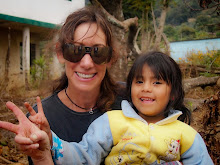
Three weeks at home and the memories are quickly fading. I've made a video of the trip, amassing all the most descriptive photos from all 7 countries visited and putting them in one place, to music. (see "View the Video," above, and click on the movie once to open it, then again to start it). I have already begun to plan a trip back - West Africa and southern AFrica in the winter of 2011. Both of these tasks help to keep my mind from leaving Africa. But writing my afterthoughts here, will help too.
Everyone keeps asking, "What was your favorite part?," "What stands out the most?"
The deep, bright color of the terra cotta soil. It seemed to be everywhere - not just in the dirt roads and the fields, but in the mud walls of the houses, the bark of the tree trunks, reflected in the sky. I even saw a reddish tint in the locals' skin color. I did. I swear I did. The color formed a rich background for the different shades of black skin, the colors of the leaves, the animals, the plains and even the clothing.
Nor can I ever forget the night we camped in a field, somewhere in Uganda, or was it Kenya? Road damage from the rains had seriously delayed our arrival at a particular location. We were never going to make it before nightfall. The safest thing to do was to camp in an open field. It was so dark by the time we stopped that we didn't really know what kind of field it was, or what was nearby, if anything. (I woke up next to a 4 foot-high termite mound). The Village Chief was consulted first, of course, and with his permission and protection we pitched our tents and had a very quick, tasteless dinner. But at 5 am I was awakened by the most mesmerizing of sounds. Somewhere in the distance I heard a woman chanting, calling, singing, beseeching, pleading. And a group responded in kind. This responsive solo/chorus musical dance continued for about 1 hour. It was haunting. Was someone in trouble? Were they praying to the gods? Or was I completely mistaken? Could it be an animal that was causing some kind of ruckus? No, no, it was definitely a woman. Her voice was loud and insistent and strained to reach as far as possible. How could this woman not be tired? She was relentless. And the chorus grew as the day got lighter.
The men who had been guarding us all night, told us at breakfast that the song was the Village being called to awaken. The woman was their alarm clock. And the responsive singing got louder as more villagers awoke to start their day. Although I have heard and always loved the sound of the Imams calling Muslims to prayer from Minarets in the early morning hours, nothing matched the raw simplicity of this.
And, of course, there were the people. Everywhere we went, in every country, without exception, the people greeted us with 2-handed waves, like the Queen's wave, but with both hands (and much more enthusiasm). They are industrious people. Africans live, not just survive, despite the lack of running water, nearby health care, electricity, sidewalks, or roads. They lack wheel barrels, schools that teach, police that protect, even umbrellas, and sometimes, enough sunny days to dry their clothes.
For me the hardest thing was staying clean. Although most nights I had access to showers (perhaps with only cold water), the dust flies everywhere and both my body and clothes were always dirty at the end of the day. How hard it must be for the Africans who don't have the luxury of even a cold shower nearby.
And everyone walked. They walked with babies on their backs and on their fronts, they walked with bananas and buckets of water on their heads, they walked with bicycles carrying loads of firewood and families of 5. And, of course, it always seemed that they were walking uphill. They were coming and going to market, to funerals, to school and to their fields. In America the only people who walk are the exercisers - walking in a hurry to raise their heartbeat. Africans walk slowly to conserve their energy and in a rhythm that is synced to the rain, or the strength of the sun, or to eachother.
When I first got home and walked through the door, I was, at that very first instant, stunned by the excess - do I really need 15 pocketbooks and so many pairs of shoes? Does the grocery store have to be the size of a football field and have 500 different kinds of cereal? Why so many restaurants, roads, and types of deodorant? It was all so unnecessary and disproportionate to needs. It was just plain . . . . excessive.
I have many more thoughts and rememberances - but those I will keep to myself - for now.
Tuesday, April 27, 2010


Saturday, April 3, 2010
CAPE TOWN
Paris has the Eiffel Tower, Rome has the Coliseum. St. Louis has its arches and New York has . . . well, everything. But Cape Town has Table Mountain, perhaps the only urban area with a natural, not man-made icon. Smack in the middle of this gorgeous city is an enormous, 3,000-foot high, black granite mountain, with a completely flat top – hence its name. Lion's Head and Signal Hill are two small, pointy-top mountains that flank it on either side. A climate phenomenon creates low-lying clouds that often cover the table top and roll down to the sea, draping over the mountain’’s sides – and is known as the “tablecloth.” With no time to climb up one of the 300 paths, we took the cable car, which rotates as it ascends, 360 degrees, so that the view is constantly changing.
The view from above will always be remembered.
The enormity and vastness of the table surface hit first as we exited the crowded cable car. We couldn't see to the end of the table. As we made our way to the edge of the surface top, along rock pathways, the view took our breathe away. The sea in all directions, with the city sitting comfortably between the mountain and the water, winding its way all around the base. The fog tablecloth had descended and was sitting just offshore.
We walked around the tabletop for about two hours, with a new surprise at every edge and view overhang. The lawyer in me, no, the AMERICAN in me, was astounded that there were no railings along the table's edges - just like on the gorge's edge in Victoria Falls. Hasn't anyone ever fallen overboard? Don't the authorities on this continent worry about fallen tourists and other litigious souls? How refreshing it is to literally, live on the edge when on Municipal property. We could stare death and daring in the face, with relatively little risk. The adrenaline was pumping.
We reluctantly scurried and left the mountain and its heady view and vast openness to rent
a car and head to the wine country, only one short, traffic-free hour from the center of the city. We had a glorious, lazy, lunch on the patio of a decadent winery, and walked through the very-Litchfield-like town until we headed back to the city for a quick nap.
Dinner was special. We went to a place called “Africa Café,” owned by an Australian and his native wife. There was no menu. Dinner was described as "Communal," and the 16 small dishes represented cuisine from all over Africa. There was Kenyan cocunut chicken, Ethiopian sik sik wat, (don't ask), Xhosa ithanga fritters, Malawi mbatata cheese & sim sim balls, (no, not THAT kind), Moroccan herb salad, and Swaziland pineapple cake with fresh yogurt, to name just a few. We ate from brightly-colored and unmatched ceramics dishes served by natives, dressed in clothing that coordinated with the colors of the dishes, the tablecloths and the walls. Everywhere there was color - African color. The servers sang and danced as they served and the building was a leftover from the Colonial era. It was the freshest, tastiest food I have had in a very long time.
On our second and last full day here we drove about 1 hour away to Cape Point, the southernmost point in Africa and the place where the Indian and Atlantic Oceans meet. The drive was impressive. Miles and miles and miles of just the right amount of winding road, along a very rugged coast on our right and the granite and pink sandstone mountains on our left. It was very similar to the Pacific Coast Highway in California, but the mountains were not as far from the coast and the road was sea level. And this was Africa - not Hollywood! And, there were baboons, ostrich and penquins along the way.
Dinner was back in Cape Town, on the waterfront, outdoors, with heaters, as the South African summer is quickly waning and autumn is setting in.
We are packing now. Our flight home is scheduled to depart at 3 pm.
Goodbye Africa.
The view from above will always be remembered.
The enormity and vastness of the table surface hit first as we exited the crowded cable car. We couldn't see to the end of the table. As we made our way to the edge of the surface top, along rock pathways, the view took our breathe away. The sea in all directions, with the city sitting comfortably between the mountain and the water, winding its way all around the base. The fog tablecloth had descended and was sitting just offshore.
We walked around the tabletop for about two hours, with a new surprise at every edge and view overhang. The lawyer in me, no, the AMERICAN in me, was astounded that there were no railings along the table's edges - just like on the gorge's edge in Victoria Falls. Hasn't anyone ever fallen overboard? Don't the authorities on this continent worry about fallen tourists and other litigious souls? How refreshing it is to literally, live on the edge when on Municipal property. We could stare death and daring in the face, with relatively little risk. The adrenaline was pumping.
We reluctantly scurried and left the mountain and its heady view and vast openness to rent
a car and head to the wine country, only one short, traffic-free hour from the center of the city. We had a glorious, lazy, lunch on the patio of a decadent winery, and walked through the very-Litchfield-like town until we headed back to the city for a quick nap.
Dinner was special. We went to a place called “Africa Café,” owned by an Australian and his native wife. There was no menu. Dinner was described as "Communal," and the 16 small dishes represented cuisine from all over Africa. There was Kenyan cocunut chicken, Ethiopian sik sik wat, (don't ask), Xhosa ithanga fritters, Malawi mbatata cheese & sim sim balls, (no, not THAT kind), Moroccan herb salad, and Swaziland pineapple cake with fresh yogurt, to name just a few. We ate from brightly-colored and unmatched ceramics dishes served by natives, dressed in clothing that coordinated with the colors of the dishes, the tablecloths and the walls. Everywhere there was color - African color. The servers sang and danced as they served and the building was a leftover from the Colonial era. It was the freshest, tastiest food I have had in a very long time.
On our second and last full day here we drove about 1 hour away to Cape Point, the southernmost point in Africa and the place where the Indian and Atlantic Oceans meet. The drive was impressive. Miles and miles and miles of just the right amount of winding road, along a very rugged coast on our right and the granite and pink sandstone mountains on our left. It was very similar to the Pacific Coast Highway in California, but the mountains were not as far from the coast and the road was sea level. And this was Africa - not Hollywood! And, there were baboons, ostrich and penquins along the way.
Dinner was back in Cape Town, on the waterfront, outdoors, with heaters, as the South African summer is quickly waning and autumn is setting in.
We are packing now. Our flight home is scheduled to depart at 3 pm.
Goodbye Africa.
REENTRY
We knew we had returned to the modern world immediately upon our arrival to the Johannesburg, South Africa airport, a layover on our way to Cape Town.
We were dazzled by the machine. The 10 large TV screens hanging in a circle in the upper reaches of the domed ceiling of the central hub of the airport were all perfectly coordinated. The pictures on each screen moved like synchronized swimmers, going from faces to toast to warnings about hazardous materials at the exact same instant. Everyone moved at a fast, but not frenzied pace, and with such purpose! The toilets flushed, the lights were bright and the floors, the walls, the countertops all glimmered. The clothes that people wore were clean, not ragged, and their outfits matched. Everyone was wearing shoes, and the shoes fit. And everywhere, as far as the eye could see, were white people. Only the employees – the janitors, the baggage handlers, the check-in clerks behind the airlines counters, were black. But this is a black country. Overwhelmingly black – 40 to 1 black. Where were they all? The employee uniforms were clean, pressed and looked brand new. The employees had a pep in their step and didn’t look bored. They were moving, not sitting. They went out of their way to help us.
Our ride into the city was no less shocking. Road maintenance crews were using bulldozers, backhoes, front-end loaders and earth moving machines, equipment that we haven’t seen in a very long time – and in such numbers. In the “other” Africa, road maintenance crews used only shovels. There was passenger traffic - in both directions - and there were passenger cars, gleaming towers, signs, traffic controls. There was a fast highway, with guardrails, and the city could be seen in the distance.
Hotel check-in was a breeze. The staff (black) was awake, they smiled and sought to carry our bags. The room has a heated bathroom floor, a shower AND a bathtub, a hair dryer and NO mosquito netting.
We fell into bed, anxious to begin our visit tomorrow morning.
We were dazzled by the machine. The 10 large TV screens hanging in a circle in the upper reaches of the domed ceiling of the central hub of the airport were all perfectly coordinated. The pictures on each screen moved like synchronized swimmers, going from faces to toast to warnings about hazardous materials at the exact same instant. Everyone moved at a fast, but not frenzied pace, and with such purpose! The toilets flushed, the lights were bright and the floors, the walls, the countertops all glimmered. The clothes that people wore were clean, not ragged, and their outfits matched. Everyone was wearing shoes, and the shoes fit. And everywhere, as far as the eye could see, were white people. Only the employees – the janitors, the baggage handlers, the check-in clerks behind the airlines counters, were black. But this is a black country. Overwhelmingly black – 40 to 1 black. Where were they all? The employee uniforms were clean, pressed and looked brand new. The employees had a pep in their step and didn’t look bored. They were moving, not sitting. They went out of their way to help us.
Our ride into the city was no less shocking. Road maintenance crews were using bulldozers, backhoes, front-end loaders and earth moving machines, equipment that we haven’t seen in a very long time – and in such numbers. In the “other” Africa, road maintenance crews used only shovels. There was passenger traffic - in both directions - and there were passenger cars, gleaming towers, signs, traffic controls. There was a fast highway, with guardrails, and the city could be seen in the distance.
Hotel check-in was a breeze. The staff (black) was awake, they smiled and sought to carry our bags. The room has a heated bathroom floor, a shower AND a bathtub, a hair dryer and NO mosquito netting.
We fell into bed, anxious to begin our visit tomorrow morning.
Subscribe to:
Posts (Atom)