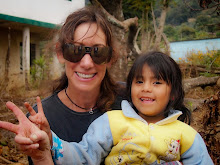
I can't believe they call this "work!"
For 3 days we are based in Patan, only 3.2 miles. from Kathmandu, but more than 30 minutes drive because of the insane traffic here. One lane and no shoulders for cars, bikes, motorcycles, pedal cabs and pedestrians, all colliding as they maneuvre through the congestion. Its every man (and woman) for himself. My leg brushed up against several motorcycle exhaust fans and I walked into a car's side mirror, slamming it inward against the car's window. Both the window and my arm survived intact.
Patan is the home base of ex-pats, NGO's (the acronym for non-governmental organizations such as Amnesty International), their employees and approximately 163,000 Nepalese. There is little visible sign of the many tourists who come to Kathmandu to equip themselves and organize treks to the nearby Himalayan mountains, including the world's highest peak, Mt. Everest.
Patan's central square is an open air museum, filled with at least a half dozen or more temples, surrounded by shops, cafes, residences and a fabulous museum about the Hindu gods. Non-residents (i.e. tourists) are required to pay $2.50 for the privilege of walking in the area.
Our first meeting was with UNFPA - the UN's population fund which works to improve the lives of women and children, in particular. PROOF always partners with local and international partners in order to produce a custom exhibition and program suited for regional needs.
According to a report commissioned recently by UNFPA and others, one in five women in Nepal reported a lifetime experience of physical violence and one in ten reported a lifetime experience of sexual violence. Trafficking of girls for sex in India is of particular concern. Other specific forms of violence in Nepal include dowry-related violence, widow abuse, polygamy and accusations of witchcraft.
There is a statute of limitations here of a mere 35 days for a victim of rape to report the crime. Further, domestic violence is not considered a crime at all. Its appalling but not surprising that seventy-five percent of Nepalese women who have experienced sexual or physical violence did not report the crime. Lack of trust in the police and judiciary, the failure to prosecute even the most egregious of crimes, and the potential stigma and social isolation from her community dis-incents survivors from reporting the rape.
UNFPA is particularly focused on changing the 35-day reporting limitation and in strengthening the domestic violence laws.
PROOF discussed providing a 2-day conference and workshop that would bring together policymakers, womens' rights NGO's and survivors during the 16 Days of Activism (Against Gender Violence), scheduled to take place globally from Nov. 25-Dec. 10, 2014. In addition, an exhibition including photographs and oral testimonies taken from those women and girls brave enough to tell their stories, will travel to 16 regions during the 16 days of activism. The goal is to educate survivors about where and how to obtain psychological, social and medical help; get the policymakers to enact appropriate laws and to raise awareness in communities that the victim is not to blame.
Tomorrow we'll meet with a representative of the international Human Rights Watch as well as several local NGO's. PROOF needs as many partners as possible to help with not just finding the participants but for funding as well.
Want to support PROOF's work here and elsewhere around the world? click here
More about Nepal..............
After Delhi, Agra and Varanasi (more about crazy Varanasi in the next post), Kathmandu is positively civil. There's a desperation in Indian cities that is hard to take. The madness of surviving the traffic, pollution, filthy streets, the mass of people, the homeless dogs, the wandering cows, and the beggars are no where to be seen here where the streets are paved and spotless and I've seen only 1 beggar 1 dog and no cows. The extremes of poverty and wealth are not nearly as obvious or ubiquitous here as in India, where multi-million dollar apartment complexes overlook vast slums. Here in Nepal's capital, the rich, I guess, are hidden behind garden walls because I haven't seen anything that would give them away.
BUT while India has electricity and heat 24/7 (for those rich enough to afford it) electricity is only turned on from 1pm until about 7pm. No lights (or heat) in our room. We did somehow have intermittent hot water in our shower this morning which warmed us up a bit after a somewhat chilly night (just above freezing).
Tomorrow evening we leave for Kolkata (formally known as Calcutta) to meet with partners on a project there. I've never been to the city made famous by the work of Mother Theresa and the book, City of Joy, one of my all-time favorites.
Its back to bedlam.
For 3 days we are based in Patan, only 3.2 miles. from Kathmandu, but more than 30 minutes drive because of the insane traffic here. One lane and no shoulders for cars, bikes, motorcycles, pedal cabs and pedestrians, all colliding as they maneuvre through the congestion. Its every man (and woman) for himself. My leg brushed up against several motorcycle exhaust fans and I walked into a car's side mirror, slamming it inward against the car's window. Both the window and my arm survived intact.
Patan is the home base of ex-pats, NGO's (the acronym for non-governmental organizations such as Amnesty International), their employees and approximately 163,000 Nepalese. There is little visible sign of the many tourists who come to Kathmandu to equip themselves and organize treks to the nearby Himalayan mountains, including the world's highest peak, Mt. Everest.
Patan's central square is an open air museum, filled with at least a half dozen or more temples, surrounded by shops, cafes, residences and a fabulous museum about the Hindu gods. Non-residents (i.e. tourists) are required to pay $2.50 for the privilege of walking in the area.
Our first meeting was with UNFPA - the UN's population fund which works to improve the lives of women and children, in particular. PROOF always partners with local and international partners in order to produce a custom exhibition and program suited for regional needs.
According to a report commissioned recently by UNFPA and others, one in five women in Nepal reported a lifetime experience of physical violence and one in ten reported a lifetime experience of sexual violence. Trafficking of girls for sex in India is of particular concern. Other specific forms of violence in Nepal include dowry-related violence, widow abuse, polygamy and accusations of witchcraft.
There is a statute of limitations here of a mere 35 days for a victim of rape to report the crime. Further, domestic violence is not considered a crime at all. Its appalling but not surprising that seventy-five percent of Nepalese women who have experienced sexual or physical violence did not report the crime. Lack of trust in the police and judiciary, the failure to prosecute even the most egregious of crimes, and the potential stigma and social isolation from her community dis-incents survivors from reporting the rape.
UNFPA is particularly focused on changing the 35-day reporting limitation and in strengthening the domestic violence laws.
PROOF discussed providing a 2-day conference and workshop that would bring together policymakers, womens' rights NGO's and survivors during the 16 Days of Activism (Against Gender Violence), scheduled to take place globally from Nov. 25-Dec. 10, 2014. In addition, an exhibition including photographs and oral testimonies taken from those women and girls brave enough to tell their stories, will travel to 16 regions during the 16 days of activism. The goal is to educate survivors about where and how to obtain psychological, social and medical help; get the policymakers to enact appropriate laws and to raise awareness in communities that the victim is not to blame.
Tomorrow we'll meet with a representative of the international Human Rights Watch as well as several local NGO's. PROOF needs as many partners as possible to help with not just finding the participants but for funding as well.
Want to support PROOF's work here and elsewhere around the world? click here
More about Nepal..............
After Delhi, Agra and Varanasi (more about crazy Varanasi in the next post), Kathmandu is positively civil. There's a desperation in Indian cities that is hard to take. The madness of surviving the traffic, pollution, filthy streets, the mass of people, the homeless dogs, the wandering cows, and the beggars are no where to be seen here where the streets are paved and spotless and I've seen only 1 beggar 1 dog and no cows. The extremes of poverty and wealth are not nearly as obvious or ubiquitous here as in India, where multi-million dollar apartment complexes overlook vast slums. Here in Nepal's capital, the rich, I guess, are hidden behind garden walls because I haven't seen anything that would give them away.
BUT while India has electricity and heat 24/7 (for those rich enough to afford it) electricity is only turned on from 1pm until about 7pm. No lights (or heat) in our room. We did somehow have intermittent hot water in our shower this morning which warmed us up a bit after a somewhat chilly night (just above freezing).
Tomorrow evening we leave for Kolkata (formally known as Calcutta) to meet with partners on a project there. I've never been to the city made famous by the work of Mother Theresa and the book, City of Joy, one of my all-time favorites.
Its back to bedlam.